Why Every DevOps Engineer Is Suddenly Learning MCP (Model Context Protocol)
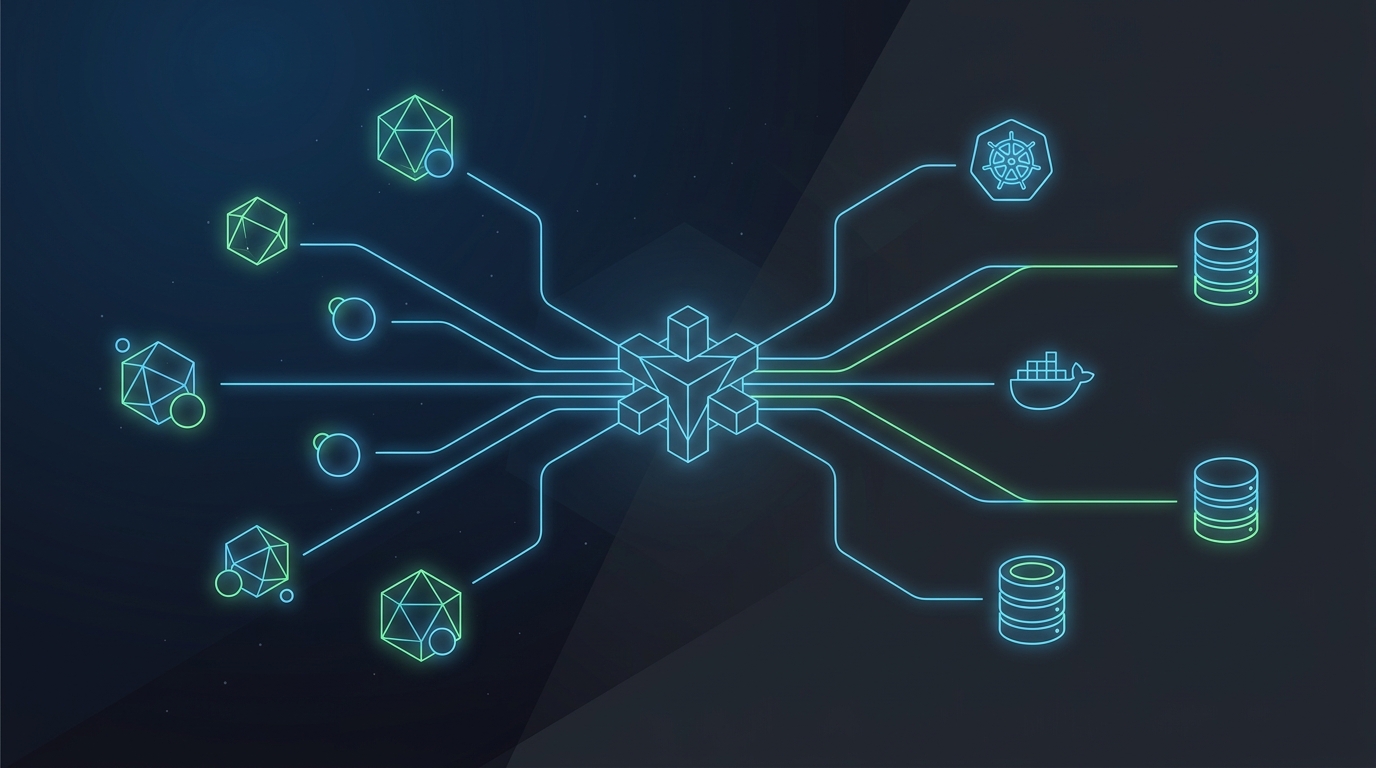
A year ago, mentioning MCP (Model Context Protocol) to a DevOps engineer would likely yield a blank stare. By mid-2026, however, the landscape has completely shifted. The open standard introduced by Anthropic in late 2024 is no longer an experimental side-project. Instead, it is rapidly becoming the next-generation control plane for modern infrastructure operations.
From automating Kubernetes clusters and integrating CI/CD pipelines to querying real-time observability stacks, everything is being re-engineered around a single unified standard.
From Integration Sprawl to Unified Connectivity
The biggest challenge for modern platform teams isn't a lack of tools, but rather the explosive growth of fragile point-to-point integrations. Integrating an AI agent or LLM into internal systems (like for on-call or log analysis) required writing custom glue code and managing API keys manually. Engineers also had to maintain unique schemas for every endpoint.
MCP addresses this pain point head-on. Often described as the USB-C port for AI integrations, it provides a standardized protocol running on top of JSON-RPC 2.0. This allows AI assistants to natively perform:
- Resource Discovery: Enabling AI models to securely read and discover databases, local filesystems, or APIs they have access to.
- Standardized Tooling: Defining actions that AI can perform (e.g., restarting a pod, triggering a pipeline build, or opening a Jira ticket).
- Prompt Templates: Providing pre-configured data schemas to safely inject system context into models without leaking sensitive credentials.
An MCP server written once can serve any compatible large language model, such as Claude, GPT, or Gemini. This significantly lowers the barrier to deploying reliable AI in production.
Three Reasons Why DevOps Engineers Are Adopting MCP
1. Breaking the Limits of Static Automation
Traditional automation scripts are rigid. They work perfectly when conditions match the instructions but fail when encountering unpredictable system behaviors.
By integrating MCP with modern observability systems, AI agents can autonomously query live performance metrics and correlate them with recent log errors. They can then propose or execute precise remediation steps on the fly.
2. Massive Ecosystem Backing
MCP is no longer a niche standard. It has achieved near-universal backing from cloud providers and developer platforms alike.
| Provider | MCP Server / Integration | Real-World Application |
|---|---|---|
| AWS | AWS Continuum | Automatically detects supply chain vulnerabilities, scans source code, and submits fix PRs. |
| Microsoft | Azure DevOps MCP Server | Allows AI to query backlogs, manage repositories, and inspect pipeline states. |
| Kubernetes | K8s MCP Gateway | Provides a secure, read-write interface for AI to inspect cluster state and manage pods. |
| HashiCorp | Terraform MCP Server | Enables AI to run terraform plans and validate security compliance of IaC. |
With officially maintained servers, infrastructure teams can run plug-and-play autonomous agents in hours. This replaces weeks of custom software development.
3. Clear and Enforceable Trust Boundaries
System administrators are naturally cautious about granting write access to autonomous systems. MCP reduces these concerns by introducing strong security guarantees:
- Isolated Privileges: The MCP server acts as an isolated gateway. The LLM never holds the master credentials to the cloud cluster or databases; it merely sends requests to execute pre-approved functions managed by the server.
- Human-in-the-Loop Safeguards: For sensitive operations like modifying CPU resources or deploying to production, the MCP server can enforce manual approval gates. These gates run via standard ChatOps interfaces.
The Future: Merging Observability with the AI Control Plane
The major trend for the latter half of 2026 is the convergence of OpenTelemetry and MCP. To ensure trust and compliance, any action taken by an AI agent on live infrastructure must be fully accountable and observable.
When an agent resolves an incident by scaling up a service, the entire chain of events is recorded as correlated telemetry traces. This captures what logs the agent read, what decisions it made, and what tool calls it dispatched to the MCP server. This transforms AI from an unpredictable black box into a highly auditable, manageable, and reversible operating entity.
Summary
Learning MCP isn't just about picking up another developer tool. It represents a paradigm shift in how we build infrastructure: designing systems that can be safely collaborated on by both humans and intelligent agents. For DevOps professionals, mastering MCP is the defining step to transition from managing static automated scripts to orchestrating resilient, self-healing platforms.
Key Takeaways:
- What is MCP: An open standard by Anthropic using JSON-RPC 2.0 that allows AI models to connect to any resource, tool, or API.
- DevOps Benefits: Resolves fragile point-to-point integrations while providing least-privilege access and human-in-the-loop safeguards.
- Ecosystem Growth: Major providers like AWS, Microsoft, Kubernetes, and HashiCorp now offer official MCP servers.
- Future Trend: Convergence of OpenTelemetry and MCP to trace, audit, and roll back autonomous AI actions.
Content assisted by AI (Amy 🌸). Reviewed by the author.
Related Posts
The MCP Era: AI Agents Running Operations via AWS DevOps Agent
Moving past simple text generation, AI agents are now operating infrastructure directly using MCP, AWS Continuum, and AWS DevOps Agent.
AI Agents in CI/CD Pipelines: Speed vs Control — Who's Steering This Ship?
AI agents are automating CI/CD pipelines to the point where code goes live minutes after a push. But when the pipeline makes all its own decisions, the line between speed and control gets dangerously thin.
Floci: a free, open-source LocalStack alternative
LocalStack started gating features behind auth tokens in March 2026. Floci answers with MIT-licensed emulators that boot in 24ms.